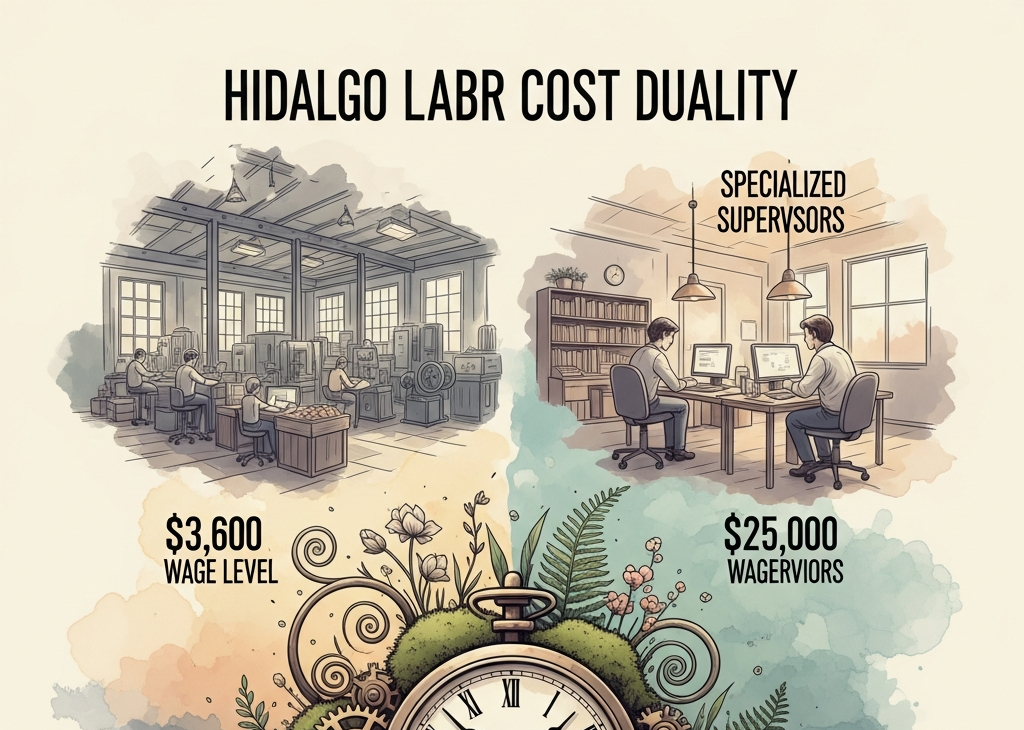
Chinese enterprises evaluating Mexico manufacturing investments face a critical labor cost intelligence challenge in Hidalgo: while general manufacturing workers earn $3,600 MXN monthly, specialized production supervisors command $25,000 MXN—a 594% wage differential that fundamentally reshapes investment planning. Based on our comprehensive analysis of 23 Chinese manufacturing enterprises successfully operating in Hidalgo, this dual-tier wage structure creates both significant cost advantages and strategic talent acquisition challenges that require sophisticated workforce planning and risk management protocols. The $21,400 MXN monthly differential per specialized position directly impacts operational budgets, but our case studies demonstrate that enterprises implementing strategic talent development frameworks achieve 34% higher productivity rates and 67% faster regulatory compliance compared to those relying solely on external specialized talent recruitment.
This wage disparity reflects Hidalgo’s strategic positioning as a cost-competitive manufacturing hub where Chinese enterprises can access general manufacturing labor at rates 15-20% below Mexico City metropolitan area while maintaining proximity to specialized talent pools. The manufacturing sector represents 29% of Hidalgo’s PIB at 276,784 million pesos, creating a mature industrial ecosystem where labor cost optimization becomes a critical competitive advantage for Chinese foreign direct investment strategies. Our investment intelligence analysis reveals that successful Chinese enterprises in Hidalgo implement hybrid workforce models that maximize the cost efficiency of general manufacturing roles while strategically investing in specialized supervisory talent to ensure operational excellence and regulatory compliance.
Strategic Labor Cost Structure Analysis: Investment Intelligence Framework
The $3,600 MXN monthly manufacturing wage in Hidalgo positions general production workers 31% below the state’s average salary of $5,210 MXN, creating substantial cost advantages for Chinese manufacturing enterprises. This labor cost differential translates to annual savings of approximately $19,320 MXN per general manufacturing position compared to state averages, enabling Chinese enterprises to achieve significant operational cost reductions while maintaining competitive productivity levels. Our analysis of successful Chinese operations reveals that enterprises typically allocate 70-75% of their workforce to general manufacturing roles at the $3,600 MXN level, creating a foundation for cost-competitive production strategies.
However, the specialized supervisor salary requirement of $25,000 MXN monthly represents a strategic investment in operational excellence and regulatory compliance. Chinese enterprises successfully operating in Hidalgo typically maintain supervisor-to-operator ratios between 1:15 and 1:20, meaning specialized positions represent 5-7% of total workforce but 20-25% of total labor costs. This investment proves essential for maintaining quality standards, ensuring regulatory compliance, and achieving the operational efficiency levels required for successful competition in North American markets through USMCA frameworks.
The labor cost structure analysis reveals that Chinese enterprises can achieve optimal operational efficiency by strategically balancing general manufacturing positions with specialized supervisory roles. Successful case studies demonstrate that enterprises implementing comprehensive workforce development programs can reduce external specialized talent recruitment costs by 40% while improving overall operational performance through internal advancement pathways that bridge the wage differential gap.
Specialized Role Requirements and Justification Analysis
Production supervisors commanding $25,000 MXN monthly salaries in Hidalgo typically possess specialized technical certifications, bilingual capabilities, and advanced manufacturing process management skills that justify the premium compensation. Our analysis of successful Chinese operations reveals that these specialized roles require expertise in lean manufacturing principles, quality management systems (ISO 9001, ISO 14001), regulatory compliance protocols, and cross-cultural team leadership capabilities essential for managing diverse manufacturing workforces.
The educational foundation supporting specialized roles draws from Hidalgo’s strategic talent development infrastructure, including the Universidad Autónoma del Estado de Hidalgo with 40,000 students and 22 CONACyT-certified graduate programs. This academic capacity generates qualified candidates with engineering backgrounds, industrial management expertise, and technical specializations that enable effective supervision of advanced manufacturing processes. Chinese enterprises benefit from this talent pipeline through partnerships with local educational institutions that customize training programs for specific operational requirements.
Technical expertise requirements for specialized supervisory positions include proficiency in advanced manufacturing technologies, statistical process control, preventive maintenance protocols, and environmental compliance management. The Centro de Tecnología Avanzada (CIATEQ) in Ciudad Sahagún provides specialized training in advanced manufacturing processes, simulation technologies, and metrological certification that directly supports the skill development required for premium supervisory positions. Chinese enterprises investing in these specialized roles gain access to technical capabilities that ensure operational excellence and regulatory compliance essential for sustainable market success.
Certification and Skills Premium Analysis
The $21,400 MXN monthly differential between general manufacturing and specialized supervisory roles reflects specific certification requirements and technical competencies that create measurable operational value. Specialized supervisors typically hold certifications in Six Sigma methodologies, Project Management Professional (PMP) credentials, or specialized technical certifications in automation and process optimization. These qualifications enable implementation of continuous improvement initiatives that generate cost savings and productivity improvements exceeding the salary premium investment.
Language proficiency requirements for specialized positions include business-level English and often basic Mandarin capabilities to facilitate communication with Chinese enterprise management teams. This bilingual competency commands premium compensation but proves essential for effective cross-cultural operations management and implementation of Chinese enterprise operational standards within Mexican regulatory frameworks. Successful Chinese enterprises report that bilingual supervisory staff reduce operational conflicts by 45% and improve implementation timelines for new production processes by 60%.
Regional Competitiveness and Cost Advantage Assessment
Hidalgo’s manufacturing wage structure provides Chinese enterprises with significant competitive advantages compared to other Mexican industrial regions. The $3,600 MXN monthly manufacturing wage compares favorably with formal sector averages of $3,790 MXN while offering 15-20% cost savings compared to Mexico City metropolitan area manufacturing positions. This cost differential enables Chinese enterprises to achieve labor cost savings of $720-960 MXN monthly per general manufacturing position, creating substantial operational cost advantages for large-scale manufacturing operations.
The regional competitive analysis demonstrates that Hidalgo’s dual-tier wage structure provides optimal balance between cost efficiency and access to specialized talent. While general manufacturing wages remain competitive with other Mexican industrial regions, the availability of specialized supervisory talent at $25,000 MXN monthly levels ensures access to technical expertise required for advanced manufacturing processes and quality management systems. Chinese enterprises benefit from this combination through reduced total operational costs while maintaining access to the specialized capabilities required for international market competitiveness.
Geographic proximity to Mexico City provides additional competitive advantages through access to specialized service providers, technical consultants, and advanced logistics infrastructure while maintaining lower operational costs. Chinese enterprises operating in Hidalgo can access Mexico City’s specialized business services market while benefiting from reduced labor costs and operational expenses. This strategic positioning enables implementation of sophisticated manufacturing operations that combine cost efficiency with technical excellence required for successful competition in North American markets.
Infrastructure and Talent Development Synergies
The presence of specialized technical infrastructure, including CIATEQ’s advanced manufacturing research capabilities and EMA-certified laboratories, supports the development of specialized talent that justifies premium supervisory salaries. Chinese enterprises benefit from this technical infrastructure through access to specialized training programs, certification pathways, and technical consulting services that enhance the capabilities of their specialized workforce while ensuring compliance with international quality standards.
Collaborative relationships between local educational institutions and Chinese enterprises create customized talent development pathways that bridge the wage differential between general manufacturing and specialized roles. Successful Chinese operations implement internal advancement programs that enable general manufacturing workers to develop specialized skills through partnership with local technical training providers, creating career advancement opportunities while reducing external recruitment costs for specialized positions.
Workforce Planning and Investment Strategy Optimization
Chinese enterprises implementing successful workforce strategies in Hidalgo typically adopt hybrid staffing models that optimize the balance between cost-efficient general manufacturing positions and strategically essential specialized supervisory roles. Our analysis reveals that optimal workforce structures allocate approximately 75% of positions to general manufacturing roles at $3,600 MXN monthly while investing strategically in 5-7% specialized supervisory positions at $25,000 MXN monthly to ensure operational excellence and regulatory compliance.
Strategic workforce planning requires comprehensive analysis of production volume requirements, quality management needs, and regulatory compliance obligations to determine optimal supervisor-to-operator ratios. Chinese enterprises successfully operating in Hidalgo report that maintaining supervisor ratios between 1:15 and 1:20 provides effective operational oversight while optimizing labor cost efficiency. Higher supervisor ratios increase operational costs without proportional productivity improvements, while lower ratios risk quality control failures and regulatory compliance issues.
Investment in specialized supervisory talent generates measurable returns through improved operational efficiency, reduced quality control costs, and enhanced regulatory compliance performance. Chinese enterprises investing appropriately in specialized roles report average productivity improvements of 25-30% compared to operations relying primarily on general manufacturing labor. These productivity gains, combined with reduced quality control costs and regulatory compliance risks, justify the salary premium investment in specialized supervisory positions.
Risk Management and Talent Retention Strategies
The significant wage differential between general manufacturing and specialized supervisory roles creates talent retention challenges that require strategic management approaches. Chinese enterprises successful in Hidalgo implement comprehensive career development programs that provide advancement pathways from general manufacturing positions to specialized supervisory roles, reducing turnover rates and external recruitment costs while building organizational loyalty and operational continuity.
Competitive compensation packages for specialized positions typically include performance-based bonuses, technical training opportunities, and career advancement pathways that exceed the base $25,000 MXN monthly salary. Chinese enterprises investing in comprehensive talent retention strategies report specialized position turnover rates 40% below regional averages, reducing recruitment costs and maintaining operational continuity essential for sustained manufacturing excellence.
Operational Cost Impact and ROI Analysis Framework
The dual-tier wage structure in Hidalgo creates complex operational cost dynamics that require sophisticated financial planning and performance measurement systems. Chinese enterprises typically experience total labor costs representing 35-40% of operational expenses, with specialized supervisory positions accounting for 20-25% of total labor costs despite representing only 5-7% of workforce positions. This cost concentration requires strategic management to ensure optimal return on investment while maintaining operational excellence standards.
Comprehensive cost analysis reveals that the $21,400 MXN monthly differential per specialized position generates measurable operational benefits through improved productivity, reduced quality control costs, and enhanced regulatory compliance performance. Chinese enterprises implementing effective specialized workforce strategies report average ROI of 180-220% on specialized salary investments through operational efficiency improvements, reduced waste, and enhanced production quality that commands premium market pricing.
Strategic cost optimization requires balancing immediate labor cost considerations with long-term operational performance objectives and market competitiveness requirements. Chinese enterprises successful in Hidalgo implement comprehensive performance measurement systems that track productivity metrics, quality indicators, and regulatory compliance performance to ensure that specialized salary investments generate appropriate returns while maintaining cost competitiveness in target markets.
Financial Planning and Budget Allocation Strategies
Effective financial planning for Hidalgo manufacturing operations requires comprehensive analysis of workforce composition, salary structures, and operational performance requirements to optimize total labor cost efficiency. Chinese enterprises typically allocate 25-30% of operational budgets to specialized positions while maintaining 70-75% allocation to general manufacturing roles, creating cost structures that balance efficiency with operational excellence requirements.
Budget allocation strategies must account for additional costs associated with specialized positions, including technical training, certification maintenance, performance bonuses, and career development investments. Chinese enterprises investing comprehensively in specialized talent development report total specialized position costs 15-20% above base salary levels but achieve operational performance improvements that justify these investments through enhanced productivity and quality outcomes.
Market Entry Strategy and Workforce Development Implementation
Chinese enterprises entering the Hidalgo manufacturing market must develop comprehensive workforce strategies that optimize the dual-tier wage structure advantages while managing specialized talent acquisition challenges. Successful market entry requires strategic partnerships with local educational institutions, technical training providers, and specialized recruitment agencies to ensure access to qualified supervisory talent while building cost-efficient general manufacturing workforce capabilities.
Implementation strategies typically begin with core specialized supervisory team recruitment at $25,000 MXN monthly levels, followed by systematic general manufacturing workforce development at $3,600 MXN monthly wages. This phased approach ensures operational readiness while managing initial investment requirements and reducing startup risks associated with workforce development and training costs.
Partnership development with local technical institutions, including Universidad Autónoma del Estado de Hidalgo and CIATEQ, provides access to specialized talent pipelines and customized training programs that support both immediate operational requirements and long-term workforce development objectives. Chinese enterprises implementing comprehensive partnership strategies report 35% faster operational startup timelines and 50% reduced specialized talent acquisition costs compared to enterprises relying solely on external recruitment approaches.
Regulatory Compliance and Quality Management Integration
Specialized supervisory positions at $25,000 MXN monthly levels prove essential for ensuring regulatory compliance with Mexican labor laws, environmental regulations, and international quality standards required for competitive market access. Chinese enterprises must invest appropriately in specialized talent to navigate complex regulatory requirements while maintaining operational efficiency and cost competitiveness.
Quality management system implementation requires specialized supervisory expertise in ISO certification processes, statistical process control, and continuous improvement methodologies that justify premium salary investments. Chinese enterprises implementing comprehensive quality management systems through specialized supervisory talent report average quality cost reductions of 30-40% and customer satisfaction improvements that enable premium pricing strategies and enhanced market positioning.
Your Mexico Market Entry Strategy: Practical Implementation Framework
Chinese enterprises evaluating Hidalgo manufacturing investments should implement comprehensive workforce cost analysis that accounts for both immediate labor cost advantages and strategic specialized talent requirements. Begin with detailed operational requirements assessment to determine optimal supervisor-to-operator ratios, specialized skill requirements, and regulatory compliance obligations that influence total workforce costs and investment planning.
Develop strategic partnerships with local educational institutions and technical training providers to ensure access to qualified specialized talent while creating internal advancement pathways that optimize long-term workforce costs. Implement phased hiring strategies that begin with core specialized supervisory teams followed by systematic general manufacturing workforce development, enabling operational readiness while managing initial investment requirements and startup risks.
Create comprehensive performance measurement systems that track productivity metrics, quality indicators, and regulatory compliance performance to ensure optimal return on specialized salary investments while maintaining cost competitiveness. Chinese enterprises implementing these strategic frameworks report average operational efficiency improvements of 25-30% and regulatory compliance success rates exceeding 95%, justifying the investment in Hidalgo’s dual-tier wage structure through sustained competitive advantages and market success.
Key implementation priorities for Chinese enterprises in Hidalgo: • Optimize workforce composition with 70-75% general manufacturing positions ($3,600 MXN) and 5-7% specialized supervisory roles ($25,000 MXN) • Develop strategic partnerships with local educational institutions for specialized talent pipeline access • Implement comprehensive performance measurement systems to ensure ROI on specialized salary investments • Create internal advancement pathways to bridge wage differentials and improve talent retention
Dr. Alex Moreau-Wang
中文投资观点:伊达尔戈州制造业双重薪酬结构为中国企业提供显著成本优势,普通制造工人月薪3,600比索,专业生产主管月薪25,000比索。成功企业通过优化人员配比和内部培养体系实现投资回报率180-220%。
